Phytophthora pluvialis
Information about Phytophthora pluvialis, including how to report sightings.
Read the latest press release on Phytophthora pluvialis.
Phytophthora pluvialis, is a fungus-like pathogen known to affect a variety of trees including western hemlock, tanoak, pine (Pinus radiata, Pinus patula and Pinus strobus) and Douglas-fir. It was originally reported in Oregon, USA in 2013 on tanoak and Douglas fir and was subsequently identified as the pathogen responsible for ’red needle cast’ of radiata pine in New Zealand.
Phytophthora pluvialis was discovered in a woodland in Cornwall in September 2021, where it was found to be affecting mature western hemlock and Douglas-fir trees. Following extensive surveillance, further outbreaks have been found in Cornwall, Devon, Cumbria, Surrey and at multiple sites in Scotland and Wales. For further information on the Scotland finding and management approach please visit the Scottish Forestry website. For further information on the findings in Wales please visit the Welsh Government website.
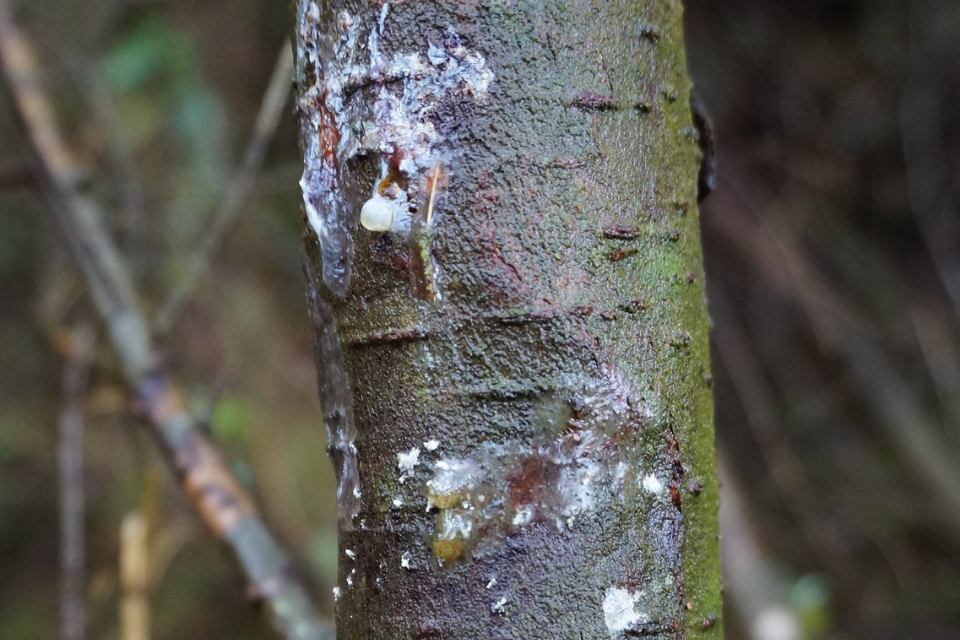
Example of Phytophthora pluvialis lesions on a tree stem.
Symptoms
Phytophthora pluvialis is known to cause needle cast, shoot dieback, and lesions on the stem, branches, and roots.
Read the which illustrates some of the symptomatic trees from which Phytophthora pluvialis has been detected in the UK.
Reporting Sightings
Please remain vigilant for signs of Phytophthora pluvialis. If you think you have spotted signs of this disease anywhere in Great Britain then please tell us using TreeAlert.
Report suspected sightings in Northern Ireland using Treecheck, the all-Ireland tree pest reporting tool.
The Plant Health (Phytophthora pluvialis) Demarcated Area Notices
A risk assessment has been done by the UK Plant Health Risk Group, which has concluded that Phytophthora pluvialis meets the criteria to be classified as a GB quarantine pest for regulatory purposes. To protect England against this disease, under powers conferred by The Official Controls (Plant Health and Genetically Modified Organisms) (England) Regulations 2019, the Forestry Commission has introduced demarcated areas around the confirmed outbreak sites, and introduced movement restrictions on materials capable of spreading the disease using Notices. Two demarcated areas are currently in place:
-
Demarcated Area No.8 Notice comes into force on 4 March 2022 replacing the which was issued on 20 January 2022 and applies to parts of Cornwall and Devon. The covers parts of Cornwall and Devon within the boundaries shown in the demarcated area and within , which also contains a description of the boundary
-
Demarcated Area No.7 Notice comes into force on 27 January 2022 replacing the which was issued on 3 December 2021 and applies to parts of Cumbria. The covers parts of Cumbria within the boundaries shown in the demarcated area and within the , which also contains a description of the boundary
-
Demarcated Area No.9 Notice comes into force on 4 March 2022. The covers parts of Herefordshire within the boundaries shown in the demarcated area and within the , which also contains a description of the boundary. A corresponding Demarcated Area Notice has been issued in Wales for this outbreak site, covering parts of Powys.
The Notices prohibit the movement of any wood, isolated bark and trees (including live trees, felled or fallen trees, fruit, seeds, leaves or foliage) of the genus Tsuga, Pseudotsuga, Pinus and Notholithocarpus, that has originated within the demarcated area.
Provision is made within the Notices to enable plant health inspectors to authorise movements and processing of material from the demarcated area where this can be achieved without risking the spread of Phytophthora pluvialis.
The Notices also now include an additional restriction on the felling of susceptible material within the demarcated areas, unless the Forestry Commission has been notified in writing in advance.
Landowners must provide notice of their intention to fell relevant material at least 14 days in advance of any felling in the demarcated areas. Felling may only commence once written authorisation is provided the Forestry Commission. For all enquiries please contact: ppluvialis.authorisation@forestrycommission.gov.uk.
You can also request an authorisation for plants for planting and Christmas trees - please contact your local APHA inspector planthealth.info@apha.gov.uk.
Last updated 25 February 2022 + show all updates
-
A new Demarcated Area Notice No. 8 (Cornwall and Devon) will come into force on 4 March 2022 and will replace Demarcated Area Notice No. 6. A new Demarcated Area Notice No. 9 (Herefordshire) will be introduced on 4 March 2022.
-
Page updated to reflect a further finding in Scotland.
-
New notices comes into force on 27 January 2022 replacing notices no.4 and no.5
-
Information on getting authorisation for felling in the demarcated areas has been updated.
-
New demarcated areas and notices that will come into effect on 10 December 2021.
-
Link to most recent press release updated.
-
Updated to reflect that a new Notice will come into effect on 26 November 2021 with a new demarcated area introduced for parts of Cumbria.
-
Updated notice and demarcated area that will come into effect on 19 November 2021.
-
Phytopthora pluvialis symptom guide added to the page.
-
Addition of a link to the risk assessment.
-
First published.