SMILE (Solar wind Magnetosphere Ionosphere Link Explorer)
mission
SMILE
UK willinvolvement studyin the interactionSMILE between(Solar the Earth’s magnetosphere and solar wind –Magnetosphere chargedIonosphere particlesLink streamingExplorer) from the Sun.mission.
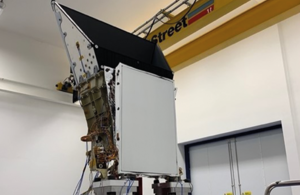
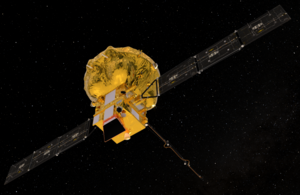
Artist's
SXIStructureimpression Thermalof ModelSMILE duringspacecraft. vibration test at STFC RAL Space in July 2021. Credit: University of Leicester.
ESA
Overview
SMILE will use a new scientific technique to provide a fuller understanding of the
Sun-EarthSun–Earthconnection.connection,Itadding to our scientific knowledge and helping us understand space weather impacts. It will deliver global 3D imaging of the Earth’s magnetosphere for the first time and investigate its dynamic response to the impact of solar wind.Overview
- SMILE will study the interaction between the Earth’s magnetosphere and solar wind – charged particles streaming from the Sun
- The UK is providing the core scientific instrument, the Soft X-ray Imager
(SXI),(SXI), and co-leads the mission’s scientific consortium - The mission is the first full scale collaboration between the European Space Agency
(ESA)(ESA) and the Chinese Academy of Sciences(CAS)(CAS)
The Earth’s magnetosphere is the strongest of all the rocky planets in our Solar System and is thought to have played an important role in the Earth’s habitability. Scientists believe that a key reason Mars lost most of its atmosphere and surface water was because it lost its magnetosphere.
SMILE is expected to answer three questions:
- What are the fundamental modes of the dayside solar wind/magnetosphere interaction?
- What defines the substorm cycle?
- How do Coronal Mass Ejections-driven storms arise, and what is their relationship to substorms?
In order
toto answeranswer(i.e.,(i.e., thethe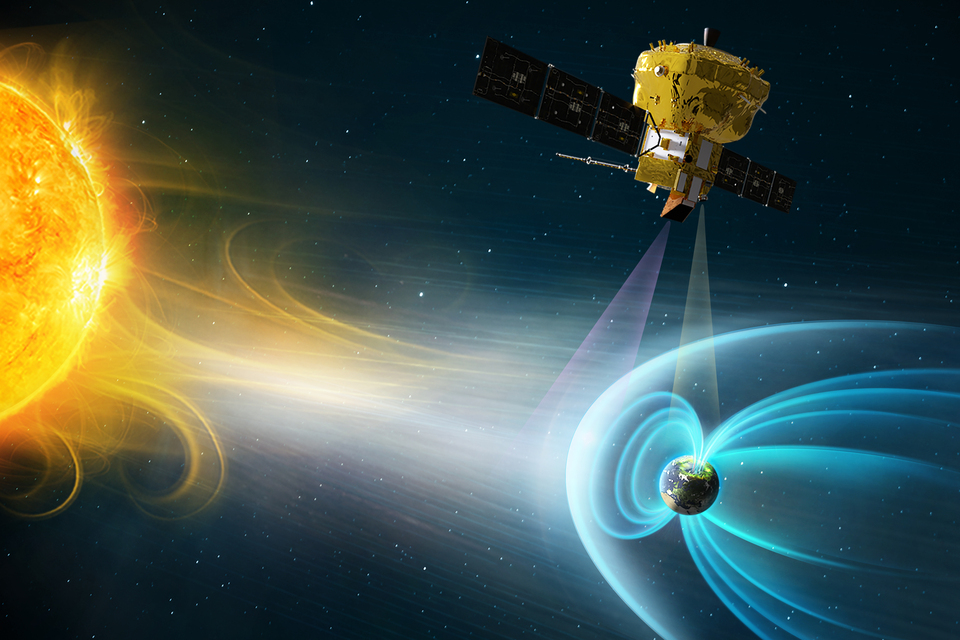
SMILE will give us the first complete look at how the solar wind leads to geomagnetic storms and auroras. Credit: ESA
UK involvement
Leadership of the overall mission science and the SXI instrument enables the UK teams to shape
itsSMILE’s scientific data in line with their requirements and areas of expertise. In-depth instrument knowledge will mean that the UK research base is well placed to understand and exploit the data in the post-launch research and discovery phase.Areas in which the UK is world leading - planetary science (Earth and beyond), solar physics, space plasma and astrophysics - are all served by the science explored by
SMILE.SMILE.SMILE data will also provide real-world benefits by helping to improve scientific models used to forecast space weather.
Extreme space weather could disrupt modern technology by causing geomagnetic storms affecting satellite navigation, shortwave communications, and power grids. A recent ESA study estimated the potential socio-economic impact in Europe from a single, extreme space weather event could reach €15 billion. Much of this disruption could be avoided through accurate forecasting.
The UK SMILE team has already carried out preliminary work with the Met Office Space Weather Operations Centre in view of supporting their work with SMILE data.
Teledyne e2v, based in Chelmsford, are supplying the SXI CCD detector devices under an approx.
£1.5M£1.5 million contract toESA.ESA. Joint academic-industry knowledge exchange with Open University on the CCD development programme will improve space radiation hardiness of the devices, maintaining this key UK technology for commercial sales and export opportunities.UK company
PhotexPhotek Ltd has also been contracted to assemble the camera for the UVI instrument.Further socioeconomic impact will be realised through:
Technologytechnology development in X-ray detection instrumentation; the SXI detectors devices are the largest ever flown for X-ray detectionSkillsskills development in the academic institutes and the industrial supply chainMaintainingmaintaining UK reputation and world leading status in SMILE science, leading to follow on projects, further fundingNewnew and strengthened international partnerships with China, Canada, and European consortium
UK
SpaceAgencyofanduprolesUK
toSpace£10.5Agencymillionfunding will supportisagreedtosupportinin 2026,2023,Overall mission Co-Principal
Investigator:Investigator: DrProfColinGraziellaForsyth UCL-MSSL. LeadsBranduardi-Raymont,UCL-MSSL.LeadsScienceScience Centre,Center,SXI instrument Principal Investigator: Dr
StevenSteven Sembay (UniversitySembay(UniversityLeicesterLeicester led theledthetechnology.technology.UCL-MSSLUCL-MSSL also provide SXI front end electronics(FEE),(FEE), and Co-Investigator support role on Chinese led Light Ion Analyserinstrument.instrument.SXI
Co-Investigator:Co-Investigator: DrProfDavidAndrewHallHollanddetectors.detectors.SXI CCD detectors provided by Teledyne e2v (Chelmsford, UK) under separate contract to
ESA.ESA.CurrentTimeline, current status&and next steps-
UK-China joint proposal selected by ESA and CAS in
20152015 -
Phase B1 study, and all instrument and mission level System Requirements Reviews, completed in
20182018 -
ESA Member States voted to formally adopt SMILE in March
20192019 -
SXI Preliminary Design Review complete in
20202020 -
SXI flight instrument
deliverydeliveredscheduledtoforSMILEmid-2023PLM in June 2024 -
Launch
datedate plannedendforof20242026