16 to 19 funding: how it works
An overview of 16 to 19 education funding and how we calculate.
Applies to England
Summary
We fund fund:
- sixth-form
colleges, - further education (FE)
colleges, - sixth forms in
schools, - sixth forms in
academies, - special
schools, - special
academies, - independent learning providers (ILPs
), - local
authorities, - special post-16 institutions (SPIs)
and - some higher education institutions (HEIs
).
We fund these institutions to provide study programmes and T Levels for young people.for:
We fund:
- students aged 16 to 19
- students up to the age of 25 when they have an education, health and care (EHC) plan
- 14 to 16-year-olds who are directly enrolled into eligible FE institutions
- home educated students of compulsory school age at any FE college
We use the 16 to 19 funding formula to calculate an allocation of funding to each institution, each academic year. We fund special schools and special academies using place numbers only. We do not use the 16 to 19 funding formula for these institutions.
We calculate the basic funding for institutions using funding rates, which depend on the size of their students’ study programmes or T Levels. These rates are regardless of which type of institution they study at or what they study. We then apply the other elements of the funding formula. To attract funding, a student must meet the published eligibility criteria, such as residency requirements. These are set out in the funding regulations guiderules for the appropriate academic year. Students must stay on their study programme or T Level for a certain amount of time to qualify for funding. Further information about qualifying periods is available in the student numbers section.
What’s new
We publish pages for each academic year so it’s easy to see what has changed.
Funding formula and study programmes
We use the 16 to 19 funding formula to fund institutions to deliver study programmes and T Levels to their students. At enrolment, the institution and the student agree what each student is going to study. The institution provides a learning agreement/timetableagreement showingor timetable showing:
- what the programme is
and - the qualification and non-qualification planned hours that make up the
programme.
You can read more about planned hours in the planned hours for study programmes section in our funding regulationsrules for post-16 provision.
The institution must tailor study programmes to the prior attainment of each student, have clear study and/or employment goals reflecting the student’s prior attainment, show progression in learning, and should include:
- substantial qualifications that stretch students and prepare them for education at the next level or for employment, although this is not a requirement for the T Level foundation year
- English and maths, where students have not yet achieved a GCSE grade 4
- work experience to give students the opportunity to develop their career choices and to apply their skills in real working conditions, and
- other non-qualification activity to develop students’ character, broader skills, attitudes and confidence and support progression
Most study programmes have a core aim. The core aim of a study programme is either a substantial qualification, which can be academic or vocational, or work experience. The core aim will usually be the component with the largest amount of timetabled activity associated with it. Study programmes can only have one core aim at a time. Core aims are an essential part of the funding allocations calculation.
How the 16 to 19 funding formula works
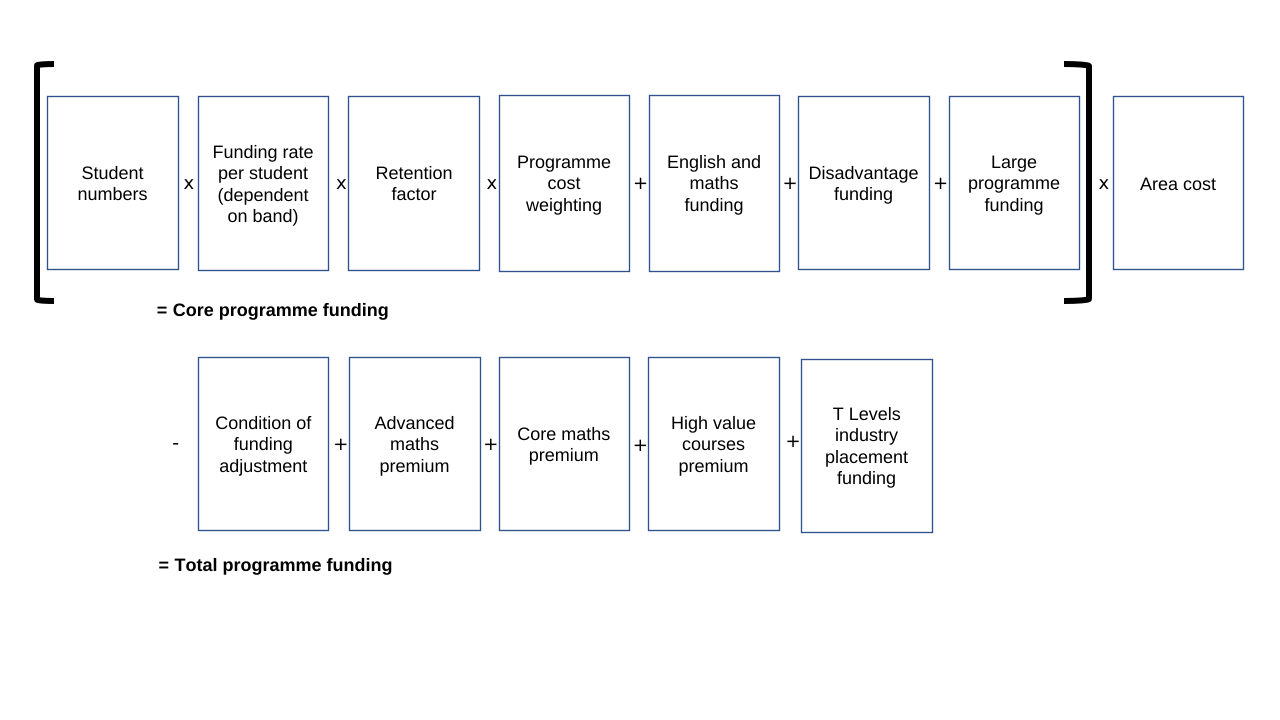
We use a funding formula to calculate institutions’ allocations each academic year. There are several elements within the 16 to 19 funding formula that make up the core programme funding and total programme funding. The diagram below shows the elements of the funding formula.
Figure 1: 16 to 19 funding formula
Core programme funding
To calculate core programme funding, we take the student numbers and multiply them by:
- funding rate per student (dependent on funding band)
- retention factor
- programme cost weighting
We then add:
- English and maths funding
- disadvantage funding
- large programme funding
and multiply the total by:
- area cost
Total programme funding
To calculate total programme funding, we take the total core programme funding and:
- subtract the condition of funding adjustment, then add
- advanced maths premium
- core maths premium
- high value courses premium
- T Level industry placement funding
Total funding
We add the following elements where appropriate to the total funding:
- care standards funding
- high needs students funding
- student support funding, above the minimum discretionary bursary funding of £500
You will find a full description of each element within the 16 to 19 funding formula and how we use them on this page.
We take the data to calculate each element from data returns submitted by institutions. This information is mainly collected via the the:
-
individualised learner record (ILR), for FE
institutions,andthe - autumn school census, for schools and
academies.
Institutions must submit regular and accurate data returns to the Department for Education (DfE).
For FE institutions, both the Funding Information Service (FIS) and Submit learner data provide funding reports. This enables institutions to check their data is accurate.
We created the post-16 interactive school census tool to help schools and academies submit accurate autumn census returns. ThisThe interactive tool also provides information on how we use the data returned in the autumn census to calculate funding for schools and academies. 16 to 19 funding reports are available in COLLECT, DfE’s centralised data collection and management system, throughout the autumn census returns window. We also publish 16 to 19 funding reports guidance within the school census user manual.
For 16 to 19 institutions, we provide an allocation calculation toolkit (ACT) to support allocation statements. This toolkit shows institutions how we have used their data to calculate the funding allocation for their organisation. We publish allocation guides when we issue statements to help institutions understand their allocation.
Further information is in the funding regulations guiderules and the funding rates and formula guide.
Core programme funding
We publish more information about these core elements in the relevant sections of the funding rates and formula guidance.
These are the data sources we use to calculate funding allocations for the academic year. Where there is no historic data, for example for new institutions, we use averages for a similar type of institution.
Funding rate
We determine the funding rate for each student by the size of their study programme or T Level based on their planned hours.
We fund all 16 and 17-year-old full-time students at the same funding rate per student, per year, where the size of programme is the same. The funding rate can vary between academic years.
We publish the funding rates each academic year:
Retention factor
Retention means whether a student completed their programme (were retained) or withdrew/droppedwithdrew or dropped out. The 16 to 19 funding formula recognises that there is a cost to institutions in delivering programmes to students who do not complete. We apply this through the retention factor, which has the effect of funding withdrawn students at 50% of their funding band’s rate.
We explain retention criteria and funding for withdrawn students in more detail in the funding rates and formula guidance for the relevant year.
Programme cost weightings
Programme cost weightings (PCWs) provide an uplift for subjects that cost more to deliver. We decide a programme’s PCWs by the core aim’s sector subject area (SSA) tier 2 classification for study programmes. For T Level programmes the PCW is determined by mapping occupational specialisms to apprenticeship standards to determine the most appropriate SSA and, therefore, PCW.
We publish a list of PCWs in the funding rates and formula guidance for the relevant year.
English and maths funding
This additional English and maths funding is intended to support students who have not achieved a GCSE grade 4 or above in English and maths to participate across all study programmes and T Levels by ensuring institutions have the resources to provide tailored education or other extra support where needed alongside qualifications.
Students do not need to be studying a specific level or programme to attract this funding. The maths and English condition of funding applies to all students that attract the English and maths funding element.
Disadvantage funding
Disadvantage funding consists of 2 blocks:blocks one to account for for:
- students’ economic
deprivation,andonetoaccountfor - low prior attainment in English and
maths.
We do not separate disadvantage funding and institutions are free to choose the best ways to use this additional funding to attract, retain and support disadvantaged students and those with learning difficulties and disabilities.
Large programme uplift element
Large programme funding supports students who take much larger study programmes to prepare for work and higher education. ItFrom givesacademic institutionsyear 2026 to 2027, the abilitylarge programme uplift will only apply to stretchthe theircosts mostof ablespecific studentslarger bythan offeringnormal amaths broadand rangehigh value A level programmes to support the progression of qualifications.students into priority sectors.
Area cost uplift
The costs of delivering education in London and the south-east are higher than the rest of England. Institutions in these parts of England get additional funding through the area cost uplift.
Programme funding: additional elements
We havepublish published more information about these additional elements in the relevant sections of the funding rates and formula guidance. each academic year.
Maths and English condition of funding
Students must be supported to improve their maths and/or English skills as part of their 16 to 19 study programme or T Level, where they do not hold a GCSE grade 9 to 4 (a level 2 pass grade) or equivalent qualification in these subjects.
This requirement is a condition of funding and we remove funding from future allocations for students who do not meet it.
Advanced maths premium
The advanced maths premium supports the sector to grow the number of students studying maths qualifications to level 3. Institutions can use the funding to provide whatever support they deem necessary to do this.
Core maths premium
The core maths premium is to encourage the provision of core maths qualifications and expand maths education for students up to the age of 18. It is intended to support students’ participation in programmes with core maths qualifications by ensuring institutions have the resources to provide extra hours of education or other extra support where needed to deliver core maths qualifications.
High value courses premium
The high value courses premium (HVCP) is additional funding to encourage and support delivery of selected substantial level 3 study programmes and T Levels in selected A level subjects or SSAs that lead to higher wage returns.
From 2026 to 2027, there is also HVCP for construction at level 3 and level 2. This is available to help institutions deliver more construction courses for all learners, with up to £35 million available in academic year 2026 to 2027 to support 16 to 19 funded students. The aim is to provide programmes which make students employable in construction immediately after successfully completing their study programme or T Level.
T Level industry placement funding
Industry providers should deliver placements in line with the industry placements delivery guidance.
This funding is to support the infrastructure and resource needed to plan, source, deliver and monitor industry placements. It is not to support employer costs for hosting placements.
Additional funding elements outside the 16 to 19 funding formula
We calculate some elements of 16 to 19 funding outside the formula.
Care standards
Care standards (residential) funding is for those institutions who have residential accommodation for students under the age of 18. The Care Standards Act 2000 puts extra responsibilities on these institutions, and these mean higher costs.
The funding rates and formula guide provides more information about Care Standards and how we calculate it.
High needs funding
High needs funding is for institutions that have students who are assessed by the local authority in whose area they are resident as having complex special educational needs and disabilities (SEND), which means that the authority assesses the costs of their additional SEND support as more than £6,000 per student. Institutions will receive extra funding directly from the local authority for these students, who will often (always in the case of 19 to 25 year-olds) have an EHC plan drawn up by the local authority. As well as the 16 to 19 programme funding, institutions receive:
High needs place funding
This is sometimes referred to as element 2 funding. We pay £6,000 per place, from deductions made from local authorities’ high needs funding allocations, based on data supplied by authorities or ILR data, depending on the type of institution.
High needs top-up funding
This is sometimes referred to as element 3 funding. This is additional funding determined on a per-student basis and paid directly by the relevant local authority, for the costs of additional support in excess of £6,000.
Student support
Help is available to youngstudents people in education via a range of student support schemes.
Teachers’ pensions scheme employer contribution grant payments
We have published teachers’ pensions scheme employer contribution grant payments guidance for schools and FE providers.
Qualifications funded for 16 to 19-year-olds
We fund students to undertake a study programme or T Level that contain qualifications meeting the following criteria:
- they must be offered by an awarding organisation that is recognised by Ofqual
- they must be approved for delivery by being included in the list of qualifications approved for funding
Eligible activity that is not part of a qualification can be funded. The planned hours for that activity in the study programme or T Level can be counted for funding purposes as non-qualification activity.
14 to 16-year-olds in FE and sixth-form colleges and electively home educated (EHE) students
We fund 14 to 16 year olds when they are enrolled in sixth-form or FE colleges that meet certain criteria. We fund 14 to 16-year-olds who are in a school or academy from pre-16 school funding allocations.
We fund EHE students for part-time courses in FE institutions. institutions. If an institution recruits an EHE student for a full-time course, then they are no longer home educated,educated and the institution will need to meet the criteria for direct recruitment.
EHE students are recorded in the ILR in the same way as 16 to 19 funded students.
Updates to this page
Last updated
-
We've added a link to this page to the funding rates and information for 2025 to 2026. This is in the core programme funding section. We've made some changes to the general text to make it easier to read.
Update history
2026-03-10 15:24
We’ve reviewed the page so it’s ready for academic year 2026 to 2027. We’ve added some information on high value courses premium for construction and large programme uplift that is relevant from 2026 to 2027.
2025-03-05 17:59
We’ve added a link to this page to the funding rates and information for 2025 to 2026. This is in the core programme funding section. We’ve made some changes to the general text to make it easier to read.
2024-02-13 14:00
We’ve updated this page to streamline the information and to include the new information for the 2024 to 2025 academic year.
2023-06-22 13:00
Updated with post-16 school census tool for 2023 to 2024
2023-03-17 14:27
We’ve updated the page for the 2023 to 2024 academic year.
2022-04-28 11:35
Updated to include information on 2022 to 2023 funding.