RP32: Small leaky woody dams
Find out about eligibility and requirements for the small leaky woody dams item.
This item is part of Capital Grants 2025.2026. You must read the Capital Grants 20252026 guidance to understand the rules and how to apply.
If you’re applying for this item as part of a Countryside Stewardship Higher Tier (CSHT) application, you must read the CSHT applicant’s guide to understand the rules and how to apply.
How much you’ll be paid
£461.39 for each dam.
How this item benefits the environment
Leaky woody dams slow the movement of water after high rainfall and help push water onto floodplains. They can also increase the recharge of groundwater which increases the temporary storage of flood waters within water channels and on floodplains. This can help:
- delay the passage of flood water downstream
- sediment to settle out
- reduce downstream flood risk
This item can help you protect, recover and improve biodiversity on your land.
Where you can use this item
You can only use this item with support from Catchment Sensitive Farming.
This item is only suitable in:
- streams between 1 metre (m) and 2.99m wide
- ephemeral streams and surface water run-off pathways where the overall length of dam required is less than 10m
You must use this item in either:
- catchments where permeable soils and geology allow for recharge (capture and storage) of groundwater
- catchments targeted for flood risk measures or water resource benefits
Catchment Sensitive Farming provides advice where there are water or air quality or flood risk issues linked to farming.
You may need consent from the Environment Agency, the lead local flood authority, or internal drainage board before starting any work. Read guidance on owning a watercourse for more information.
Check with Natural England (or the Forestry Commission in woodland) if you’ll need a feasibility study. Speak to Catchment Sensitive Farming about a water holding structure action plan.
What you must do to use this item
Building your leaky dam
The number and size of logs you will need will depend on the watercourse you are working on.
Choose logs which:
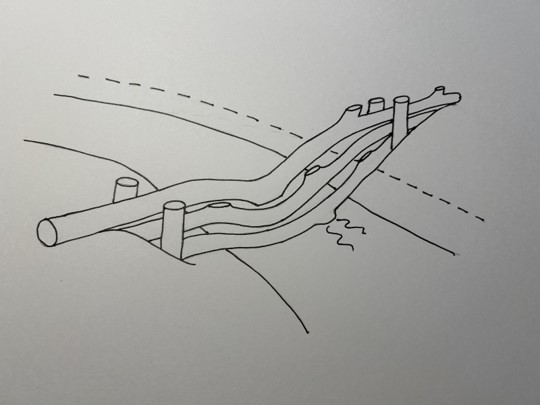
- are long enough for you to embed them into each side of the bank to stop water flowing around them
- can extend as far into the floodplain as needed to provide a stable and long-lasting structure and ensure water is diverted onto the floodplain under high flows
- has a curve or dip in the middle to funnel the flow of water to the centre of the channel where possible
- are a similar diameter
You will need enough logs to stack on top of each other so the lowest one is 0.3m above the water at low to medium flows. Use irregular shaped logs or carve into straight logs to create gaps and low points.
Install wooden stakes in each bank on both sides of the logs to secure them in place. You can use live willow stakes for this or existing trees where present.
Set stakes back from the channel edge to reduce the risk of scour. Secure the logs to the stakes or trees using sisal (natural fibre) rope or timber screws (for stakes only).
You must:
- secure the dam in line with the requirements of the Environment Agency, lead local flood authority consent or exemption (where required)
- align dams at right angles to channel banks or direction of flow to reduce bank scour (the removal of materials such as sediment from the bank)
- in streams (permanent or winterbourne), build dams to allow normal flows to always pass unimpeded – set them at 0.3m above normal flow levels
- site dams on slow flowing reaches of the water course that have on average 2m of floodplain on either side
- build dams to a height sufficient to encourage water to spread onto the floodplain upstream of the dam
- not install dams directly upstream of pinch points, such as bridges or culverts that back up flows and are likely to swamp the dam
- check and maintain dams to keep the structure effective – ensure the free gap underneath has not become blocked by debris
- follow the requirements set out in any feasibility study or Catchment Sensitive Farming water holding structure action plan (if applicable)
You should consider the effect your dam will have on the surrounding environment. For example:
- avoid using straight logs so there are gaps and low points to help create varied flow patterns
- do not use timber boards
- avoid siting the dam in areas of active bank erosion, choose a location which has stable banks
- expect the dam to create localised changes to the channel bed
- choose a site where the floodwater will not affect neighbouring landowners
- avoid locations that could damage historic or archaeological features
Example of a leaky woody dam
Evidence you must keep
You must keep written support from your Catchment Sensitive Farming adviser and provide this with your application.
You must also keep and provide with your claim:
- photographs of the completed works in place and installed
- any consents and permissions from the Environment Agency or lead local flood authority
You must also keep and provide on request:
- receipted invoices or bank statements where a receipted invoice is unavailable
- photographs of site before works start
- a copy of the feasibility study, woodland management plan or water holding structure action plan where applicable
Read the record keeping and site visit requirements in the Agreement holder’s guide: Capital Grants, Higher Tier capital grants and Protection and Infrastructure grants for more information.
If you’re applying for this item as part of a Countryside Stewardship Higher Tier (CSHT) application, read the record keeping and site visit requirements in the CSHT agreement holder’s guide.
Other items you can use with this item
You can use this item with RP11: Swales.
Advice to help you use this item
The following advice may help you to use this item, but you do not have to follow it to get paid. It’s not part of this item’s requirements.
The design and location of leaky woody dams in natural water courses are affected by:
- local circumstances such as extent of tree cover, risk of riverbed or bank erosion
- whether it is to slow flood flows or to encourage groundwater recharge
- the availability of suitable materials
- easy access to import suitable materials to site
Using the capital item FM2: Carry out customised capital works to manage specific sites or species is more appropriate for use within:
- sites of special scientific interest (SSSIs)
- rivers that are already biodiversity priority habitat rivers
- rivers that have the potential to become biodiversity priority habitat rivers
If one or more of the above apply, you should seek advice from your Natural England adviser before using this item.
Detailed design can vary. Local circumstances, availability of and easy access to suitable materials for the site can affect where you put leaky woody dams in natural water courses.
You can improve the management of water on the land, improve infiltration and the storage of water by:
- improving soil health
- increasing appropriate vegetation cover
- using rural sustainable drainage systems
.
Checking the dams for silt
You’ll need to check the dam regularly and de-silt it to prevent it collecting large amounts of silt.
Spacing between each dam
It’s best practice to build dams in a series (with a minimum 3 dams). Make sure the spacing between dams of about 7 to 10 times the width of the channel.
Large leaky woody dams
You can use RP33: Large leaky woody dams either:
- for streams and river channels between 3m and 5m
- with ephemeral streams (flows when it rains) and surface water run-off pathways where the overall length required is less than 15m
Updates to this page
-
Updated the section 'Where you can use this item'.
Update history
2026-05-28 11:08
Updated links to guidance for Capital Grants and Agreement holder’s guide from 2025 to 2026.
2025-07-03 12:34
Updated the section ‘Where you can use this item’.
2025-02-03 13:47
Amended item – you can now use this item:to reduce flood riskin catchments where permeable soils and geology allow for the recharge of groundwater
2023-01-12 12:17
The Where to use this item, Requirements, Keeping records sections of this page have been updated