Helping the Science Museum Group understand climate-related risks
GAD helped the Science Museum Group assess climate-related risks, develop bespoke scenarios, and build resilience across its estate and operations.
Credit: Science Museum Group
The Government Actuary’s Department (GAD) worked with the Science Museum Group (SMG) to assess its exposure to climate-related risks and opportunities and provide recommendations for building resilience and mitigating potential impacts.
Background
The SMG operates some of the UK’s most visited cultural institutions including the Science Museum and National Railway Museum. Their sites hold irreplaceable collections and serve millions of visitors each year.
Like all public bodies, the SMG must report on how climate change could affect its finances and operations. This requirement comes from the Task Force on Climate-related Financial Disclosures (TCFD). TCFD is a global framework that helps organisations identify, assess, and better prepare for climate-related risks. HM Treasury has published guidance to help public bodies meet this requirement.
What we did
We supported the SMG across several connected stages of work.
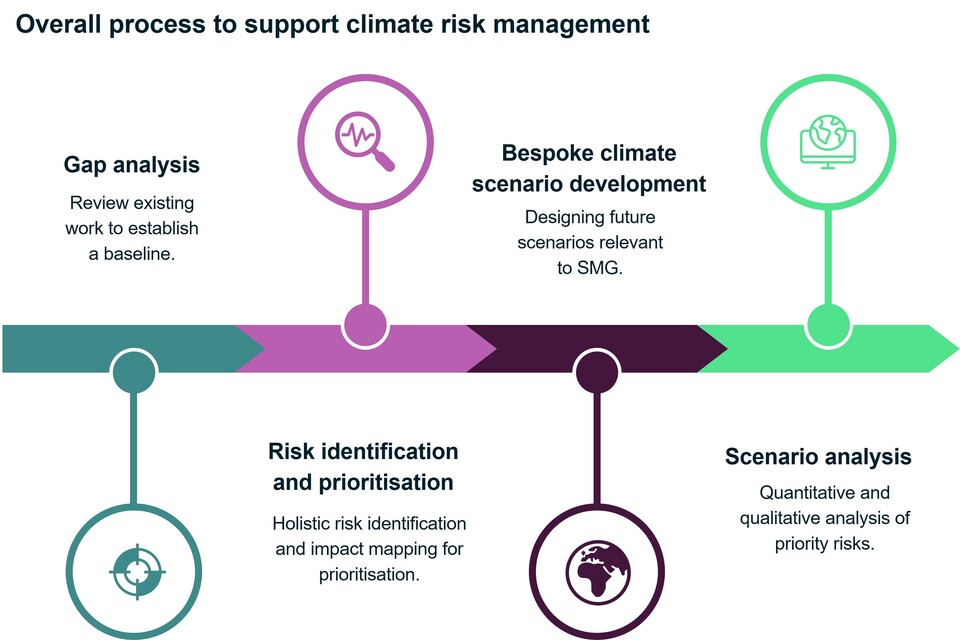
Stages of GAD support to SMG. Credit: GAD.
Gap analysis
This was the first time the SMG was formally required to consider the strategy pillar of the TCFD framework. This covers how an organisation identifies and responds to climate-related risks and opportunities across its business model and planning.
Although the requirement was new, the SMG had previously undertaken work relating to the actual and potential impacts of climate-related risks. The GAD team reviewed all relevant work to establish where current practices met disclosure requirements and where further development was needed.
This enabled us to carry out a structured assessment to help the SMG understand its starting point and prioritise next steps. This guided subsequent stages of the project.
Risk identification and prioritisation
Once we had completed the initial assessment, we facilitated collaborative workshops with a diverse range of SMG stakeholders to generate and refine a comprehensive climate-related risk and opportunity register.
We then mapped the pathways through which the physical climate hazards (such as flooding and extreme heat) and transition risks (such as regulatory change and the costs of moving to net zero) identified could lead directly and indirectly to financial and operational impacts for the SMG.
We prioritised climate-related risks using surveys of key SMG stakeholders and the SMG’s risk matrix, ensuring alignment with broader risk management processes across the organisation.
Bespoke climate scenario development
We developed 4 bespoke climate scenarios that were tailored to the SMG’s mission, strategy, estate, and operations. These scenarios translated global reference scenarios into narratives specific to the SMG.
Scenarios were informed through GAD-facilitated interactive workshops, with input from across the SMG, which led to the delivery of meaningful and relatable scenarios for the organisation.
Scenario analysis
We conducted qualitative and quantitative analysis of the prioritised physical and transition risks under the bespoke scenarios. We assessed the likelihood and financial severity of each risk across 3 timeframes and 2 scenarios to show how the risks may evolve under different climate futures.
Scenario analysis involved GAD synthesising climate data with SMG’s own financial and operational information.
We also provided a series of risk mitigation recommendations for the SMG to take forward to help build resilience to climate-related risks.
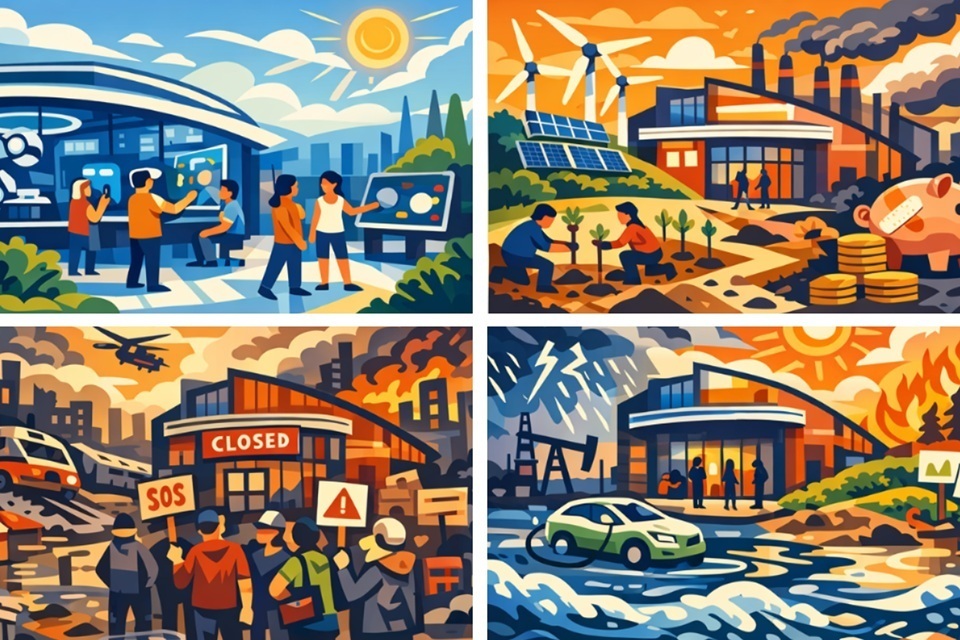
AI visualisations of 4 bespoke climate scenarios developed for the SMG. (Not intended to represent specific people or places. Credit: GAD.)
Value delivered
The project has provided SMG with a clearly prioritised set of climate-related risks and opportunities that have been assessed consistently.
The 4 bespoke climate scenarios are grounded in the SMG’s own context rather than generic national or global figures. As such, they can be integrated into existing organisation-wide risk management processes and used for ongoing strategic and financial planning, and decision-making.
The SMG now has a clear set of recommendations on climate-related risk reduction and analysis improvement to take forward.
The work gives the SMG a stronger foundation for TCFD-aligned reporting and for demonstrating climate leadership within the cultural sector.
“The Government Actuary’s Department has helped support our work to embed climate impacts, mitigation and adaptation in our thinking, and provided us with a clear set of next steps. By taking the time to understand our operations through surveys and workshops, the Government Actuary’s Department has enabled us to better describe the risks we face and the ways in which they may impact our operations.
Their development of four possible climate scenarios, and each one’s effect on our operations, supported our detailed engagement with internal stakeholders.
We are grateful to the GAD team for their support, expertise and guidance.”
David Jones, Deputy Finance Director, Science Museum Group
Working with us
The Climate and Disaster Risk team at GAD brings together expertise in climate science, risk management, and financial analysis. We use this expertise to help public bodies move from awareness to action on climate-related risks. If you are interested in finding out more, please get in touch: Climate.Change@gad.gov.uk.